Human Dignity: A Comprehensive Explanation
Core Definition
Human dignity is the idea that every person possesses an inherent, unconditional worth simply by virtue of being human. This worth cannot be given or taken away — not by governments, not by circumstances, not by personal failure or achievement. It exists independently of intelligence, ability, race, gender, wealth, or behavior.
The word innate means it comes built-in at birth (or arguably before). The word inalienable means it cannot be transferred, stripped away, or voluntarily surrendered. Even a person who commits a terrible crime retains their human dignity — which is precisely why torture, for example, is considered wrong regardless of what the prisoner has done.
This is the concept’s most radical and important feature: it is unconditional.
Philosophical Origins
Human dignity did not emerge from a single tradition — it has deep, parallel roots across philosophy, religion, and culture.
Ancient Stoicism
The Stoics (circa 300 BCE) believed every human being possessed logos — reason — and that this shared rational capacity made all people fundamentally equal and worthy of respect. A Stoic philosopher like Marcus Aurelius could write with genuine conviction that the slave and the emperor shared the same essential nature. This was a revolutionary idea in a world built on hierarchy.
Religious Traditions
- Christianity grounds dignity in the concept of Imago Dei — the belief that humans are made in the image of God, giving every person a sacred, God-given worth. This idea deeply shaped Western moral and legal thought.
- Islam holds that God breathed his spirit into humanity (nafkh al-ruh), conferring a special honour (karama) on all human beings.
- Judaism similarly emphasizes the sanctity of each individual life — the Talmud states that whoever saves a single life saves an entire world.
- Buddhism and Hinduism, while framed differently, contain strong traditions of recognizing the intrinsic value and spiritual potential of every person.
Immanuel Kant (1724–1804)
Kant gave human dignity its most influential secular philosophical formulation. His argument, stripped down:
- Human beings are rational agents — we can reason, make choices, and govern ourselves by moral law.
- This capacity for reason gives us a worth that is beyond price. Things have a price (they can be exchanged or replaced); persons have dignity (they cannot).
- His famous Categorical Imperative demands we always treat persons as ends in themselves, never merely as means — never as tools for someone else’s purposes.
This Kantian framework became the backbone of modern human rights philosophy.
The Enlightenment Onward
Thinkers like John Locke, Jean-Jacques Rousseau, and later John Stuart Mill built on these foundations to argue that political systems must respect the inherent worth of individuals — planting the seeds of democratic governance and the rule of law.
How It Differs from Earned Respect or Social Status
This distinction is crucial and often misunderstood.
| Human Dignity | Earned Respect / Status | |
|---|---|---|
| Source | Being human | Achievement, behavior, rank |
| Conditions | None | Performance-dependent |
| Can be lost? | No | Yes |
| Universal? | Yes, equally | No, varies by person |
| Example | The right not to be tortured | Being admired for bravery |
A war hero and a convicted criminal both possess human dignity equally. The war hero may have far greater social respect — and rightly so. But the criminal still has the right to a fair trial, humane imprisonment, and not to be subjected to degrading treatment. That protection flows from dignity, not from anything they have done to deserve it.
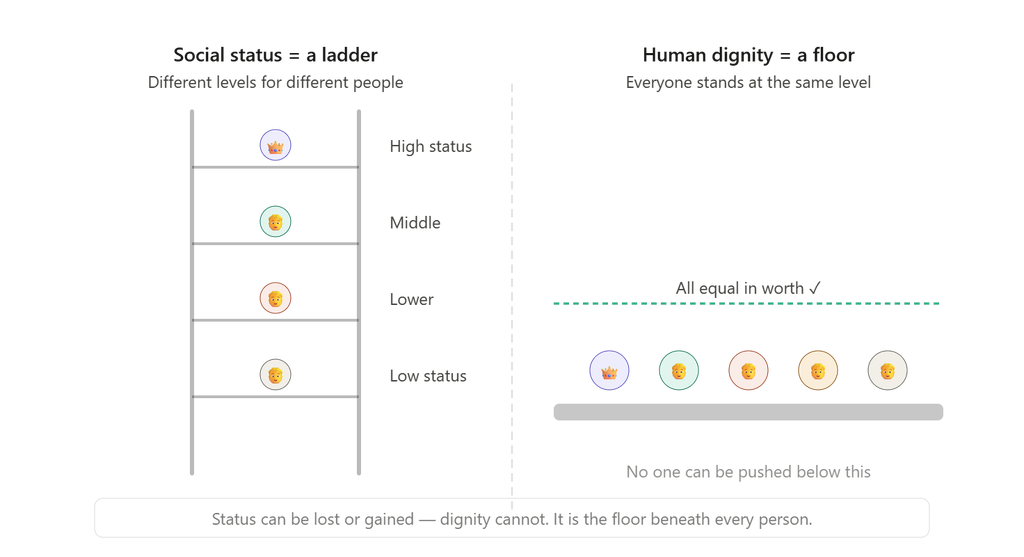
Social status is a ladder. Human dignity is a floor — beneath which no one can be pushed, regardless of where they stand on the ladder.
Its Role as the Foundation of Universal Human Rights
After the horrors of World War II — the Holocaust, mass atrocities, systematic dehumanization — the international community confronted a devastating question: How does this happen, and how do we prevent it?
The answer they reached was that atrocities become possible when people are stripped of their perceived humanity. The solution was to enshrine human dignity as the non-negotiable foundation of international law.
The Universal Declaration of Human Rights (1948) opens with exactly this logic:
“Recognition of the inherent dignity… of all members of the human family is the foundation of freedom, justice and peace in the world.”
From that single premise, all 30 Articles flow — the right to life, to freedom from slavery, to a fair trial, to education, to asylum. Each right is essentially an application of the question: What does respecting a person’s inherent worth require of us?
Many national constitutions echo this directly. Germany’s Basic Law (1949), written in the shadow of Nazism, begins: “Human dignity shall be inviolable.” It is the first line. Everything else in German constitutional law is subordinate to it.
Real-World Implications
Human dignity is not merely an abstract idea — it actively shapes law, policy, and daily life.
Criminal Justice
- Prohibitions on torture and cruel punishment (e.g., the UN Convention Against Torture) rest on dignity — even the guilty cannot be degraded or dehumanized.
- Solitary confinement debates center on whether prolonged isolation violates the dignity of prisoners by causing psychological destruction.
- Capital punishment opponents often argue it is inherently dignity-violating, treating a person as disposable.
Healthcare and Bioethics
- Informed consent — the requirement that doctors obtain a patient’s agreement before treatment — is a direct application of dignity; patients are not objects to be operated on.
- End-of-life care debates (euthanasia, assisted dying) often pit two dignity claims against each other: the dignity of autonomous choice vs. the dignity of life itself.
- Disability rights advocates invoke dignity to argue that people with disabilities must not be treated as burdens or lesser lives.
Labor and Economics
- Minimum wage laws, safe working conditions, bans on child labor — all reflect the idea that work arrangements that reduce people to pure instruments violate their dignity.
- The concept of decent work (promoted by the ILO) holds that labor should affirm rather than degrade a person’s humanity.
Social Policy
- Anti-discrimination laws (on race, gender, sexuality, religion) are rooted in dignity: to discriminate is to treat a person as less than fully human.
- Refugee and asylum law uses dignity to argue that people fleeing persecution cannot simply be turned away as inconvenient.
- Welfare state arguments often invoke dignity: a person dying of preventable poverty or illness is a dignity violation, not just an economic inefficiency.
Everyday Life
Dignity also governs how we are expected to treat each other: speaking to people with basic courtesy, not humiliating others publicly, recognizing the humanity of those who are different from us. Much of what we call common decency is informal dignity in practice.
Tensions and Debates
For all its power, human dignity is not a simple concept. It generates genuine philosophical and legal tensions.
1. Dignity vs. Autonomy
What happens when someone freely chooses something others consider degrading?
- Example: A person chooses to work in conditions others find demeaning, or consents to activities that seem self-degrading.
- Tension: Does respecting dignity mean protecting people from degrading choices, or does it mean respecting their right to choose — even unwisely?
- Germany’s Constitutional Court, taking dignity seriously, has sometimes restricted individual freedoms (e.g., banning certain performances deemed degrading) — a move that troubles liberal thinkers who see autonomy as part of dignity.
2. Whose Dignity Definition Wins?
Dignity is invoked on opposing sides of many debates:
- Abortion: Pro-life advocates argue the fetus has inherent dignity; pro-choice advocates argue the woman’s dignity includes bodily autonomy.
- Euthanasia: Some say dying with dignity means the right to choose death; others say dignity demands we never treat life as disposable.
- Hate speech laws: Some argue hateful speech violates the dignity of targeted groups; others argue restricting speech violates the speaker’s dignity and everyone’s freedom.
3. Cultural Relativity
Western liberal conceptions of dignity tend to be individualistic — centered on personal rights and autonomy. Many non-Western traditions frame dignity in more communal terms — a person’s worth expressed through their roles, relationships, and community standing.
This creates real friction in international human rights contexts: is the Western framework a genuine universal, or a particular cultural export?
4. Expanding the Circle
Who counts as a dignity-bearer? History shows this circle has been wrongly and shamefully narrow:
- Enslaved people, women, indigenous peoples, and disabled people were all once excluded from full dignity protections — sometimes through explicit legal and philosophical arguments.
- Today, debates continue about animal dignity (do great apes or elephants have something like dignity?), AI personhood, and the rights of future generations.
- These aren’t merely academic: they reflect the ongoing, unfinished work of taking the concept seriously.
5. Dignity Without Enforcement
Perhaps the most practical tension: human dignity is proclaimed universally but violated constantly. Millions live in conditions of poverty, oppression, and abuse that flagrantly contradict these principles. The gap between the ideal and reality raises hard questions about whether dignity is a genuine moral reality or an aspirational fiction — and what responsibilities it places on those with the power to act.
Conclusion
Human dignity is one of humanity’s most important moral achievements — a hard-won consensus that every person matters, unconditionally, and that this mattering must be built into our laws, institutions, and treatment of one another. It is the floor beneath all ethical and political life.
It is also unfinished work. The concept continues to evolve, to be contested, and to be applied to new situations. That tension is not a weakness — it is a sign that the idea is alive, doing real moral work in a complicated world.
To take human dignity seriously is not to recite a slogan. It is to ask, in every situation: Am I treating this person as someone whose existence has unconditional worth? That question, honestly asked and honestly answered, changes everything.
Please provide images and graphics that illustrate and support quick learning and memorization.
++++++++++++++++++++++++++++
++++++++++++++++++
Here are several visual learning aids — diagrams, a memory map, and an interactive quiz — all designed to help you quickly absorb and retain the concept of human dignity.
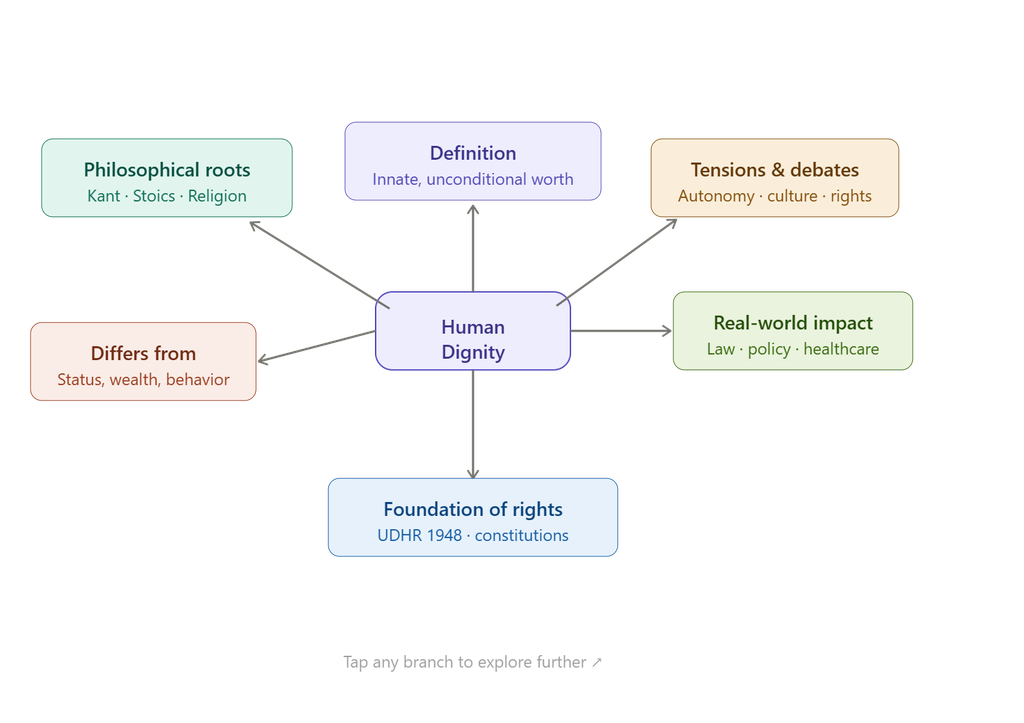
1. The Core Concept Map — showing how everything radiates from one central idea:—
2. The “Floor vs. Ladder” Visual — the single most important distinction to remember:—
3. The Philosophical Timeline — tracing dignity’s intellectual lineage:—
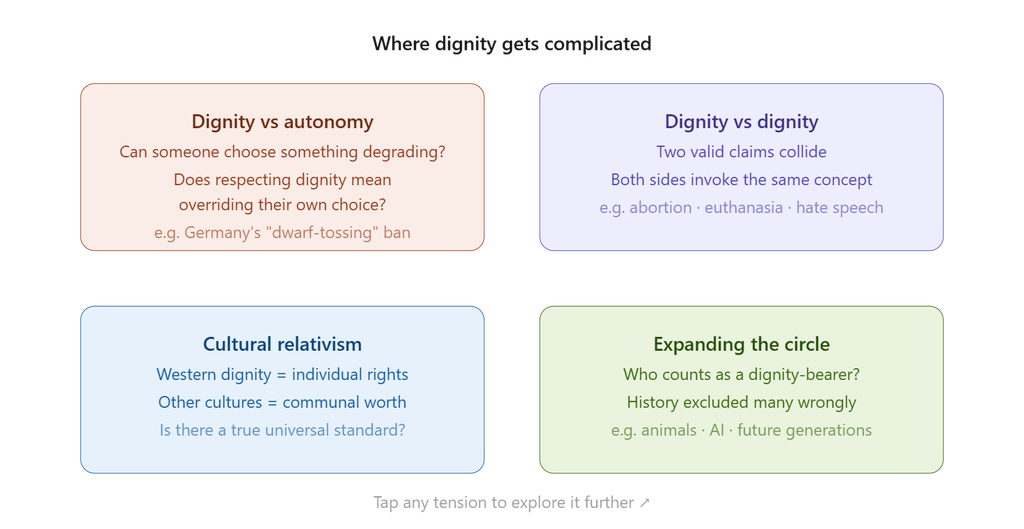
4. The Key Tensions Map — showing where the concept gets complicated:—
5. Interactive Flashcard Quiz — test yourself on the key ideas:Here’s a quick guide to using these visuals:
To build your mental model, start with the Concept Map (1) to see the big picture, then use the Floor vs. Ladder diagram (2) to lock in the most important distinction — that’s the one most students miss.
To understand the history, the Timeline (3) shows how the idea evolved over 2,300 years from Greek philosophy through to international law.
To think critically, the Tensions Map (4) covers the hard questions — perfect for essay writing or deeper discussion.
To test yourself, the Flashcard Quiz (5) covers all the essential concepts. Hit shuffle to randomize the order. Aim to answer each question before flipping — that active recall is the most powerful memorization technique there is.
++++++++++++++++
+++++++++