
The Atlantic Four-Season Islands — Best 100-Plus Stories
++++++++++++++++++++
key words, phrases, idea, to learn, to do, goals plane
SmartRosy
ROSY alon
s c ROSY S
ROSY
the rosy
receiving and giving roses as best gifts
++++++++++++++++++
Please list the most useful feature or benefit of roses, especially those qualities that are not added and are not mentioned in the story.
My first three additions would be:
- Bees and flower structure—a lively visual demonstration.
- Rose hips and wildlife food—a useful discovery beyond petals and seeds.
- A seasonal time-lapse—a natural connection to your four-season gardening theme.
John, Mike, and Emily can lead these discoveries, with ComCom and AI supplying close-up images, explanations, and supporting information.
+++++++++++++++++++++++++++++++++++++++++++++++++
Top 100 Features, Benefits, and Uses of Red Roses

Top 100 Features, Benefits, and Uses of Red Roses
An introduction at the 2050 Expo
SmartRosy Story
Story note: SmartRosy is a fictional, genetically engineered rose. Its extraordinary growing abilities, edible plant parts, and proposed health effects belong to this science-fiction setting and should not be treated as facts or advice about ordinary roses.
John addressed the guests. “Ladies and gentlemen, I’d like you to meet Mike and Emily, our expo experts in four-season gardening and flower cultivation. They specialize in growing roses with the help of smartphones and intelligent gardening technology.”
Turning to SmartRosy, he added, “SmartRosy, meet Mike and Emily. Today, you’ll help us discover how much we can learn from a single red rose.”
Mike greeted everyone with a smile. “Let’s begin with the red rose Linda gave you when you entered the salon. Hold it gently in your left hand and your smartphone in your right. Aim the camera at the flower, keeping the screen at a comfortable viewing distance.”
Emily demonstrated, and a live view from her phone appeared on the exhibition screen, allowing everyone to follow along.
“Your phone will help you observe the rose closely, read about it, watch demonstrations, listen to explanations, and record your discoveries,” Mike continued. “Whenever you want to type a question or take notes, set your rose down gently to free your hand.”
He looked around the room.
“Later, we’ll explore how four-season gardening could help provide a diverse supply of food for billions of people around the world, while also bringing more flowers—and roses of many varieties and colors—into our lives.
“For now, let’s focus on the one red rose in your hand. What can it teach us? What can we create with it? How many ways can it enrich everyday life?”
Emily pointed to the enlarged image on the screen.
“Connected to the internet and the expo’s AI supercomputer, your smartphone becomes a tool for exploring those questions. You can examine the petals, discover how the plant grows, and follow expert demonstrations of rose cultivation and care.
“Through Best100Plus, we’ll explore more than 100 rose-related features, benefits, and uses. We’ll also discover how roses inspire fashion, decorative arts, furniture design, paintings, and other creative works, with insights from artists, designers, teachers, and specialists.”
“And every discovery gives us something to talk or write about,” Mike added. “You can build your vocabulary, practice languages, and turn what you learn into stories, poems, songs, videos, and speeches.
“Try describing your rose in a few words. Then listen to how those ideas are expressed in another language. A single flower can give us a shared subject, even when we speak different languages.”
He paused as the guests examined their roses.
“Here at the 2050 Expo, you’ll also find rose-related products, services, and innovations. But our journey begins with something simple: looking closely at the flower in your hand.”
“Roses offer a remarkable variety of features, benefits, and uses,” Mike continued. “Here at the 2050 Expo, SmartRosy builds on that natural richness. This extraordinary rose has been genetically engineered to support more than 100 qualities and applications, combining beauty, fragrance, flavor, and the possibilities of future gardening.”
Emily held up a flower for everyone to see.
“Each SmartRosy bloom has approximately 100 edible petals and weighs about 100 grams. Its richly colored petals release a sweet rose fragrance and have a delicate, pleasing flavor. Our researchers have also developed specialized varieties intended to support mental, emotional, and physical well-being.”
Mike smiled. “Imagine a rose created to help ease stress, encourage relaxation, and bring moments of calm and joy into everyday life—a flower to enjoy with friends, family, and loved ones.
“Whether given for Mother’s Day, Valentine’s Day, a birthday, an anniversary, a New Year’s celebration, or a full-moon gathering, SmartRosy carries a personal message of affection and care.”
“Its purpose also reflects an ambitious hope,” Emily added. “Our long-term research explores whether SmartRosy could contribute to healthier lives extending beyond 100 years, alongside other advances in nutrition, medicine, and daily living. We hope those additional years will offer more opportunities for learning, laughter, and shared happiness. Our goal is a long life that is happy, healthy, prosperous, and informed.”
She gestured toward the flowering bushes.
“And the vision extends to the plant itself. With suitable care and the expo’s advanced four-season growing system, each SmartRosy bush can produce hundreds—or even thousands—of blooms throughout the year. These bushes are engineered for a productive lifespan of at least a century, while the most advanced varieties are designed to flourish for as long as 1,000 years.
“Imagine the generations who could care for the same bush, enjoy its flowers, and pass its story on.”
Emily moved toward a display of rose products.
“SmartRosy’s possibilities extend well beyond its beautiful blooms,” she continued. “Its fragrant petals can be used to create perfumes and rose water, while its edible petals—fresh or dried—can add delicate flavor to foods, drinking water, and comforting teas.”
Mike gestured toward a display of seeds beside the flowering bush.
“Each SmartRosy bush also produces between 100 and 1,000 seeds per year, suitable for planting or specially prepared culinary uses. In varieties developed for food production, the leaves, roots, and stems have also been engineered for culinary use, following preparation methods specific to each part.”
“That distinction matters,” Emily explained. “These qualities belong to our specially developed SmartRosy varieties. They should not be assumed to apply to ordinary rose bushes.”
“From growing new plants to preparing a fragrant cup of tea,” Mike added, “one bush opens many paths to discovery, creativity, and everyday pleasure.”
Emily lifted a freshly cut stem from a nearby vase.
“Even after cutting, SmartRosy blooms can remain fresh for one to four weeks in clean water with suitable floral nutrients. Their vase life depends on the variety and how they are cared for. This future variety is also highly resistant to insect pests and adaptable to a wide range of growing conditions. Its stems are free of sharp prickles, and its supple growth makes handling and arranging the flowers more comfortable.”
“SmartRosy is also designed to help gardens flourish and expand,” Mike continued. “With the propagation techniques developed for this future variety, a single bush can provide enough planting material to grow more than 100 new bushes each year. Mature plants can reach over 100 centimeters in height, creating generous displays of flowers and greenery.”
Emily brought up a world map on the exhibition screen.
“Our four-season growing system makes it possible to cultivate SmartRosy in more than 100 regions around the world. Whether grown indoors or outdoors, each plant receives care suited to its surroundings. Efficient watering, carefully managed lighting, and climate controls help gardeners use resources thoughtfully while meeting the plant’s needs.
“That adaptability is part of our vision for more sustainable gardening. Flowers, fragrance, food ingredients, and material for propagation can all come from the same bush. Using these resources carefully gives each plant greater practical value and helps reduce waste.”
“And those possibilities extend beyond the garden,” Mike added. “Alongside personal enjoyment and emotional well-being, SmartRosy could support livelihoods in cultivation, food production, perfumery, design, education, tourism, and gardening technology.
“Here at the 2050 Expo, our ambition is global. We envision a SmartRosy economy that could eventually support millions of jobs and contribute trillions of dollars to global GDP. Those figures describe a long-term ambition, not a guaranteed outcome. Reaching that scale would depend on successful development, widespread adoption, and responsible management.”
Emily looked toward the flowering displays.
“SmartRosy brings horticulture and technology together around a shared purpose: helping people grow beauty, knowledge, and opportunity while caring for the natural world that makes it all possible.”
She then invited the visitors to look away from their phones and toward the garden displays across the salon.
“SmartRosy’s purpose also reaches into the quieter moments of daily life,” she said. “Our research into its specialized edible varieties includes possible support for visual comfort, concentration, and memory. Those are goals we are exploring carefully.
“We also want this flower to be a simple reminder: pause, look up, and notice the world around you. Its colors, fragrance, and unfolding petals offer something worth slowing down to appreciate.”
Mike smiled. “Our invitation is simple: Enjoy a good mood, good food, and a good book—and take time to see the beauty in people and the world around you.”
He turned toward the learning displays.
“Whatever new possibilities SmartRosy may offer, learning still grows through curiosity, practice, and attention. We want to help people understand new ideas, remember what they learn, set meaningful goals, and make time for the things that matter.”
“And learning is only part of a fulfilling life,” Emily added. “Growing a plant, sharing a flower, or preparing something thoughtful for another person can become an expression of affection and care. Through these experiences, SmartRosy invites us to practice compassion, strengthen relationships, and appreciate everyday pleasures.”
“For some visitors, the rose also holds spiritual meaning,” Mike continued. “It may serve as a focus during prayer, meditation, or quiet reflection. Those who seek divine blessing may find personal meaning in its beauty, while others may welcome a moment to breathe, reflect, and reconnect with what matters to them.”
Emily looked around the room.
“That is the life we hope SmartRosy will help people cultivate—a life with room for purposeful work, continued learning, love, laughter, and satisfaction. Progress, profit, and prosperity gain meaning when they help us care for ourselves, contribute to others, and enjoy the world we share.”
John glanced at the rose in his hand.
“One flower,” he said, “and already so many things to learn, create, and share. Let’s explore them, one discovery at a time.”
++++++++++++++++++++++++
+++++++++++++++++
“Roses have several ways to produce new plants,” Mike explained.
- Self-pollinated seeds: Some roses produce seeds using pollen from the same plant.
- Cross-pollinated seeds: Pollen from another compatible rose can produce offspring with new combinations of characteristics.
- Stem cuttings: A cut section of stem develops roots and becomes a new plant.
- Layering: A stem develops roots while attached to the parent plant, then is separated.
- Root suckers: Shoots growing from the roots can sometimes be separated with their own roots.
- Budding or grafting: Gardeners attach a rose bud or stem to a compatible rootstock.
“Seeds can introduce new variations,” Emily added, “while methods such as stem cuttings help preserve a favorite rose’s characteristics.”
Correction to the original sentence: Rose flowers generally contain both male and female reproductive structures, but not every variety can successfully produce seeds through self-pollination.
These methods are described in the RHS rose-growing guide.
+++++++++++++++++++++++++
Ray, the most useful next addition would be to show SmartRosy’s abilities in action. You already have many benefits; a few demonstrations, questions, and discoveries would make them more memorable and strengthen the story’s educational purpose.
These are proposed additions, ready for you to choose from.
2. Add a “One Rose, 100 Learning Possibilities” activity
This would make your language-learning purpose visible. A visitor could begin with one word—rose—then build a phrase, a sentence, a question, and eventually a short story.
For example, the learning sequence could include:
- Naming the flower’s parts.
- Describing its color, fragrance, texture, and shape.
- Comparing two varieties.
- Asking how the plant grows.
- Explaining a use or sharing a memory.
The 100-plus possibilities can unfold across the series, allowing each scene to teach something manageable.
3. Demonstrate the smartphone connection
Show what happens when Emily points her camera at the rose. As a proposed fictional feature, the screen could offer three clear choices:
| Choice | What visitors can explore |
|---|---|
| Discover | Flower details, gardening information, cultural meanings, and sources. |
| Create | A description, poem, design, song idea, or personal message. |
| Grow | Care instructions matched to the plant and its surroundings. |
This gives readers a concrete understanding of the technology.
4. Introduce a question the experts cannot answer immediately
A visitor might ask, “How can one bush produce so many flowers without exhausting its resources?”
Mike and Emily could explain the growing system, examine its measurements, or acknowledge that a trial is still underway. A question worth investigating creates momentum and models good learning habits.
5. Give the extraordinary abilities clear conditions
Choose a few requirements that make SmartRosy’s accomplishments understandable within the fictional world:
- Abundant flowering requires suitable nutrition and care.
- Indoor growing needs an appropriate light supply.
- Different varieties serve different purposes.
- A neglected plant needs recovery time.
These conditions create opportunities for gardening lessons and small story challenges.
6. Distinguish SmartRosy varieties by purpose
Instead of giving every bush every extraordinary ability, consider a related family of varieties:
| Proposed variety | Primary purpose |
|---|---|
| Garden SmartRosy | Seasonal displays and adaptable cultivation. |
| Culinary SmartRosy | Fictional food varieties with clearly identified edible parts and preparation methods. |
| Fragrance SmartRosy | Perfume and aromatic creations. |
| Learning SmartRosy | Interactive language and educational experiences. |
| Heritage SmartRosy | The story’s exceptionally long-lived plants, cared for across generations. |
This would give visitors meaningful choices and support your “As You Like It!” philosophy.
7. Make sustainability measurable
Let Emily show a small comparison of water use, energy use, plant output, and reused materials within the fictional expo.
The lesson could be: a garden’s success includes what it produces and what it requires. Any invented measurements should be identified as results from the story’s fictional growing trials.
8. Include different needs and abilities
A visitor who cannot comfortably hold both a flower and a phone could use a stand. Another could choose larger text, audio descriptions, captions, or voice controls.
These details would make the exhibition more welcoming while demonstrating useful design.
9. Explore cultural differences in rose meanings
Invite visitors to explain what a rose means to them personally. One might remember a family garden; another might associate it with a celebration, a poem, or someone they miss.
This introduces emotional depth and language practice without assuming that every color or flower carries the same meaning everywhere. Specific cultural claims can be researched when we develop that scene.
10. End with a small personal creation
Give each visitor something to accomplish: write a dedication, record a description, create a garden plan, or choose a personal Best 10 Rose Uses list.
That turns the exhibition into participation and expresses a central Best100Plus idea: people can discover possibilities and choose what matters most to them.
My recommendation for the next revision: add SmartRosy’s first meaningful interaction, one smartphone demonstration, and a short language activity. Those three additions would strengthen the existing scene without making it crowded.
+++++++++++++++
+++++++++++++++++++++
++++++++++++++++++++++++++++++++++++++++++++++++
Top 100 Features, Benefits, and Uses of Red Roses
A SmartRosy Story at the 2050 Expo
SmartRosy is a fictional, genetically engineered rose. Its extraordinary growing abilities, edible plant parts, and proposed health effects belong to this science-fiction setting and should not be treated as facts or advice about ordinary roses.
Sunlight filtered through the salon’s glass roof, illuminating the roses beside the exhibition screens. Guests held the red flowers Linda had given them at the entrance. Some admired the petals; others lifted their roses closer to enjoy the fragrance.
John stepped forward.
“Ladies and gentlemen, welcome. I’d like you to meet Mike and Emily, our expo specialists in four-season gardening and flower cultivation. They combine practical gardening knowledge with smartphones and intelligent growing technology.”
Turning toward SmartRosy’s display, he smiled.
“And SmartRosy, today you’ll help us discover how much we can learn from a single red rose.”
A soft light appeared on the screen.
“May I begin with a question?” asked a voice.
Several guests looked up.
John nodded. “Please do.”
“What do you see when you look at the rose in your hand?”
“A flower,” someone answered.
“A gift,” said another.
“A memory,” a woman near the window added.
There was a brief silence.
“Then we already have three places to begin,” SmartRosy replied.
Emily approached the display.
“The voice you hear belongs to SmartRosy’s digital guide, connected to our exhibition system. It helps us explore the living rose, ask questions, and follow our interests.”
“And no two visitors need to take exactly the same journey,” John added. “That is part of Best100Plus: discovering useful possibilities and choosing what matters to you.”
One Rose in Your Hand
Mike held up his flower.
“Let’s begin with the rose Linda gave you. Hold it gently in one hand and aim your smartphone camera toward it with the other. Keep the screen at a comfortable viewing distance.”
Emily demonstrated. A live view from her phone appeared on the exhibition screen, revealing the folds and curves of the red petals.
“If holding both is awkward, use one of the stands on your table,” she said. “You can also choose larger text, spoken descriptions, captions, or voice controls.”
Guests adjusted their phones. Linda helped one visitor position a stand while another selected an audio description.
“Later,” Mike continued, “we’ll explore how four-season growing systems could help provide food for people around the world, alongside flowers of many varieties and colors. For now, our subject is the single rose in front of you.”
Three choices appeared on the screen:
Discover. Create. Grow.
“Choose Discover to explore the flower and learn about its uses,” Emily explained. “Choose Create to develop something of your own. Choose Grow to investigate cultivation and care.”
“Which should we choose first?” a guest asked.
“Whichever makes you curious,” SmartRosy answered.
A Flower Becomes a Lesson
Mike selected Discover. The image enlarged, and labels appeared beside the visible parts of the flower.
“Through your phone, you can examine details, read explanations, listen to specialists, and watch demonstrations,” he said. “The system connects you to the internet and the expo’s AI supercomputer. You can also check where information comes from and save questions for further study.”
Emily pointed to the word petal.
“Let’s try a short language activity. Start with one word: rose. Add a detail: red rose. Now turn it into a sentence.”
“I am holding a red rose,” a visitor said.
“Good. Can someone add an observation?”
“I am holding a red rose with soft, curved petals.”
“And a question?” Emily asked.
“Why does it smell sweet?”
Mike smiled. “Now our language lesson has opened a science lesson.”
The guests began offering questions of their own.
How does a rose grow? Why do varieties have different fragrances? What can people make from the petals? How do you describe a flower in another language?
“One rose,” John said, “and already we are naming, observing, comparing, and asking.”
“You can continue with a paragraph, a poem, a conversation, or a story,” Emily added. “Listen to the words in another language, practice saying them, and share what you notice.”
The woman near the window looked at her flower again.
“My mother grew roses beside our front door,” she said. “I think I would begin there.”
“That sounds like a story worth hearing,” John replied.
More Than 100 Possibilities
The screen changed to a gallery of gardens, clothing, paintings, furniture, fragrances, and floral arrangements.
“Through Best100Plus, we’ll explore more than 100 rose-related features, benefits, and uses,” Mike said. “Some concern the plant itself. Others concern what people create, learn, or experience through it.”
Emily moved through the gallery.
“Artists, designers, gardeners, teachers, writers, and other specialists will help us examine these possibilities. You might explore rose-inspired fashion, decorative arts, photography, perfumery, or furniture design. You might create a poem, a video, a song, or a speech.”
“Do we have to learn all 100 today?” someone asked.
“No,” John said, drawing a few relieved smiles. “Today, we begin. Each subject deserves enough attention to become useful.”
“Your first discovery might even change what you choose next,” SmartRosy added.
Meet the Living SmartRosy
Emily stood beside a flowering bush.
“Ordinary roses gave our researchers a rich starting point: beauty, fragrance, variety, and generations of human interest. SmartRosy builds on that foundation through the possibilities of our imagined future.”
She lifted a bloom for everyone to see.
“A typical exhibition bloom has approximately 100 edible petals and weighs about 100 grams. These red petals have a sweet rose fragrance and a delicate flavor. Other SmartRosy varieties offer different colors and characteristics.”
“Does every variety do everything?” a visitor asked.
“No,” Emily replied. “We select varieties for their intended purpose. A garden display, a culinary crop, and a fragrance collection may have different needs. Their care instructions and approved uses are identified in the growing guide.”
Mike indicated the rose on the screen.
“That is why learning about your particular plant matters. A name alone does not tell you everything you need to know.”
Emily nodded.
“Our research also explores specialized varieties intended to support well-being. Some of our most ambitious work concerns healthy aging. We hope future discoveries may contribute to lives extending beyond 100 years, alongside advances in medicine, nutrition, and daily living.”
“And what would we want those years to contain?” John asked.
“Learning,” someone said.
“Family.”
“Good health.”
“Enough time to enjoy them.”
Mike smiled. “Exactly. Our hope is a long life that is happy, healthy, prosperous, and informed.”
A Garden for Generations
Emily gestured toward the larger bushes behind her.
“With suitable care and the expo’s four-season growing system, a SmartRosy bush can produce hundreds—or even thousands—of blooms throughout the year. Our long-lived varieties are engineered for a productive lifespan of at least a century. The most advanced are designed to flourish for as long as 1,000 years.”
A guest leaned forward.
“How can one bush produce so much for so long? Surely it needs something in return.”
“It does,” Emily said. “Abundant growth requires water, light, nutrients, space, and continuing care. Our system manages those needs carefully. We monitor the plant’s condition and adjust its surroundings.”
“So it cannot simply be planted and forgotten?”
“Certainly not,” Mike replied. “A neglected SmartRosy would still need attention and recovery. Its extraordinary abilities make good care more valuable.”
John studied the branches.
“Imagine a family caring for the same bush across generations. Children could grow up beside it, return with their own children, and tell them who planted it.”
“The garden would hold more than flowers,” said the woman near the window.
“Yes,” John answered. “It would hold their history.”
From Petals to Possibilities
At the next display, Emily showed the guests bottles of rose water, fragrance samples, dried petals, and labeled containers of seeds.
“SmartRosy’s petals can be used in perfumes and rose water,” she explained. “Petals from varieties developed for food can also be enjoyed fresh or dried, adding flavor to dishes, drinking water, and teas.”
Mike picked up a seed container.
“A bush can produce between 100 and 1,000 seeds a year. Depending on the variety, these may be used for planting or specially prepared culinary products.”
He placed the container beside a diagram.
“In our fictional food varieties, certain leaves, roots, and stems have also been engineered for culinary use. Each part has its own preparation instructions. These qualities should never be assumed to apply to an ordinary rose bush.”
A visitor studied the diagram.
“If you use the roots, what happens to the plant?”
“That is an important question,” Emily replied. “Using more parts of a plant does not mean harvesting them all at once. A long-lived garden bush and a plant grown for a specific harvest require different plans. We must consider what we remove and what the plant needs to continue growing.”
Mike nodded.
“Thoughtful use begins with understanding.”
Growing More, Using Resources Carefully
Emily lifted a freshly cut stem from a vase.
“SmartRosy blooms can remain fresh for one to four weeks in clean water with suitable floral nutrients, depending on the variety and care. Their stems are free of sharp prickles, making them more comfortable to handle and arrange.”
“And they are highly resistant to insect pests,” Mike added, “although gardeners still inspect them and monitor their surroundings.”
A world map appeared on the screen.
“Our growing system supports cultivation in more than 100 regions,” Emily said. “Plants may be grown indoors or outdoors, with care adapted to local conditions. Mature bushes can exceed 100 centimeters in height.”
“Can visitors grow new bushes from them?” Linda asked.
“Yes,” Mike replied. “Using our propagation methods, a suitable parent bush can provide enough planting material for more than 100 new bushes in a year. Those young plants still need space, time, and care to become established.”
Emily opened another display showing water use, lighting, nutrient supply, and plant growth.
“We evaluate the whole growing system. Producing more flowers is useful, but we also need to understand the resources required. Efficient watering and carefully managed lighting help us reduce unnecessary use.”
“And gardeners can keep their own records?” asked a visitor.
“Absolutely,” Emily said. “Your observations help you understand your plants and improve your decisions.”
SmartRosy’s voice joined them.
“A useful question for any garden is: What did we grow, what did we use, and what can we improve?”
Work, Creativity, and Opportunity
Mike led the guests past displays of rose-inspired products.
“The possibilities extend beyond cultivation. SmartRosy could support work in food production, perfumery, design, education, tourism, and gardening technology.”
A guest stopped beside a collection of decorative objects.
“So someone who does not grow roses could still participate?”
“Certainly,” Mike replied. “A writer might develop learning materials. A designer might create a useful product. A teacher might build lessons. A local guide might organize a garden experience.”
“Our long-term vision is ambitious,” Emily added. “We imagine a global SmartRosy economy that could eventually support millions of jobs and contribute trillions of dollars to global GDP. Those figures are aspirations within this future world. Achieving them would require successful development, sustained demand, and responsible management.”
John looked around the displays.
“And the value must reach people. Useful work, fair opportunities, and products that serve real needs will matter as much as the size of the industry.”
A Rose in Everyday Life
After the demonstrations, Emily invited everyone to set down their phones for a moment.
“Look toward the garden across the salon,” she said. “Notice the shapes, the colors, and the spaces between the flowers.”
The room grew quieter.
“Some of our specialized edible varieties are being studied for possible support of visual comfort, concentration, and memory,” she continued. “Those research goals are separate from the simple invitation a flower can offer us: pause, look up, and pay attention to our surroundings.”
Mike smiled.
“Enjoy a good mood, good food, and a good book—and take time to see the beauty in people and the world around you.”
“Then return to your learning with a question worth pursuing,” John added.
“Whatever future discoveries SmartRosy may bring,” Emily said, “learning will still involve curiosity, practice, and attention. The flower gives us a subject. What we do with it is our part.”
Linda held her rose near the light.
“It can also give us a reason to think of someone.”
“Yes,” Mike replied. “A rose given for Mother’s Day, Valentine’s Day, a birthday, an anniversary, a New Year’s celebration, or a full-moon gathering can carry a personal message. Sometimes an ordinary day is reason enough.”
“And the meaning may differ from person to person,” Emily said. “That is something we can ask about and learn from.”
“For some,” Mike continued, “a rose also holds spiritual significance. It may accompany prayer, meditation, or quiet reflection. A person seeking divine blessing may find meaning in its beauty; another may simply appreciate a peaceful moment.”
Discover Your Best
SmartRosy’s display brightened.
“Would you like to create something before you leave?”
Three suggestions appeared:
Write a personal message.
Describe a discovery.
Begin your Best 10 Rose Uses list.
“Your list can reflect your own interests,” John said. “Perhaps gardening comes first. Perhaps language learning, art, fragrance, or giving a thoughtful gift. You can revise your choices as you learn.”
Guests returned to their phones. One recorded a short description in a language he was practicing. Another began a sketch. The woman near the window wrote about the roses beside her childhood home.
Linda moved among the tables, listening as people shared their work.
Emily turned to Mike.
“We began with a demonstration,” she said quietly.
“And now they are making it their own,” he replied.
John raised his rose.
“That is what we hope this exhibition will offer: something to learn, something to enjoy, and something useful to carry into your life.”
SmartRosy’s voice sounded once more.
“What will your one rose inspire?”
John smiled at the guests.
“Discover the Best. Create Your Best. As You Like It!”
++++
+++
John, Mike, and Emily will guide the presentation, while ComCom, the information robot, and AI can provide access to extensive knowledge as the larger story develops.
+++++++++++++++++++++++++++++
SmartRosy: Questions, Answers, and Discoveries
John — Exhibition Host:
“Welcome to the SmartRosy exhibition. At Expo 2050, we explore useful questions, learn from thoughtful answers, and put what we discover into practice—with thanks and appreciation for those who help us learn.
“Today, Mike and Emily, our gardening specialists, will guide us. ComCom, our information robot, will support the discussion with AI and research. Linda will help our visitors participate.
Emily: “Our future SmartRosy ideas belong to this science-fiction story. We introduce them with the invitation, ‘Coming soon, as you like it!’ This expresses our imagination, not a confirmed release or scientific promise.”
1. Meet SmartRosy — Coming soon, as you like it!
Question — Linda: What makes SmartRosy special?
Answer — Emily: SmartRosy is our imagined, genetically engineered rose of 2050, combining beauty, fragrance, specialized uses, and extraordinary growing possibilities.
Question — Sam, a young visitor: What features would those flowers have?
Answer — Mike: Our exhibition variety is imagined with about 100 edible petals, weighing about 100 grams per bloom, a rich red color, and a sweet rose fragrance.
Question — Linda: What makes SmartRosy special?
Answer — Emily: It gives us a way to explore future possibilities while learning about the real roses that inspire them.
2. Roses and Creativity
Question — John: What can roses inspire us to create?
Answer — Emily: Poems, stories, photographs, paintings, songs, videos, clothing designs, decorations, and useful products.
Question — Maya, a creative visitor: How can I make something original?
Answer — John: Begin with your own observation, memory, or purpose. Ask who your creation is for and what you want it to express.
Question — Anna: How do we appreciate other creators?
Answer — John: Acknowledge their contributions, give proper credit, and respect the conditions for using their work.
Question — John: For whom do roses inspire us to create? Answer — Emily: Something personal and meaningful that others can enjoy, learn from, or use.
3. How Roses Reproduce and Multiply
Question — Sam: How can one rose plant become many?
Answer — Mike: Through seeds, stem cuttings, layering, root suckers, and budding or grafting.
Question — Sam: Can a rose produce seeds using its own pollen?
Answer — Emily: Some can. Rose flowers generally contain male and female reproductive structures, but successful self-fertilization depends on the variety.
Question — Anna: What is cross-pollination?
Answer — Mike: It is the transfer of pollen from another plant. When compatible roses successfully reproduce this way, their seedlings can inherit new combinations of characteristics.
Question — David, a home gardener: How do stem cuttings work?
Answer — Emily: A cut section of stem develops roots and grows into a new plant under suitable conditions.
Question — David: What is layering?
Answer — Mike: A stem develops roots while attached to the parent plant, then is separated to grow independently.
Question — Sam: What are root suckers?
Answer — Emily: They are shoots arising from roots. Some can be separated with roots of their own; on grafted roses, they may belong to the rootstock.
Question — Anna: What are budding and grafting?
Answer — Mike: They join a bud or stem from a chosen rose to a compatible rootstock.
Question — Sam: How can one rose plant become many?
Answer — Emily: Through successful reproduction or propagation, supported by suitable conditions, knowledge, patience, and care.
4. Four-Season Growing — Coming soon, as you like it!
Question — David: How could SmartRosy flower throughout all four seasons?
Answer — Emily: In our imagined growing system, suitable varieties receive carefully managed light, water, nutrients, and temperatures.
Question — Linda: How productive could a bush become?
Answer — Mike: The story envisions hundreds or thousands of blooms annually, with specialized propagation methods providing material for more than 100 new bushes each year.
Question — Sam: Could a bush live for 1,000 years?
Answer — Emily: That is an imagined design goal for our most advanced varieties—a way to explore gardens cared for across many generations.
5. Rose Products and Culinary Uses
Question — Maya: What useful products can come from roses?
Answer — Emily: Flowers for arrangements, fragrance ingredients, rose water, and suitable food-grown petals and hips for culinary uses.
Question — Maya: Can I eat any rose I receive?
Answer — Mike: No. Confirm that the particular plant part is suitable for eating, grown for food, and prepared appropriately.
Question — Sam: What about SmartRosy’s edible leaves, roots, and stems?
Answer — Emily: Those belong to specialized varieties in our story: “Coming soon, as you like it!” They are not instructions for eating ordinary rose plants.
Most parts of Smartrosy are edible; most normal rose bushes have thorns to protect them from animals and from being eaten.
6. Caring for Gardens and Resources
Question — Linda: How can we grow roses responsibly?
Answer — Emily: Choose suitable plants, meet their needs, monitor their health, and use water and other resources thoughtfully. Observe carefully, learn from results, and improve our choices over time.
Question — David: What should I record?
Answer — Mike: Growth, flowering, watering, growing conditions, and any problems or changes in care.
Question — Sam: Does producing more always mean growing better?
Answer — Emily: No. Better growing also considers plant health, available space, resource use, and effects on the surrounding environment.
7. Work and Opportunity
Question — David: How can roses create useful work?
Answer — Emily: Through gardening, floristry, perfumery, food production, design, education, tourism, and related services. By connecting people’s skills with products, services, and experiences that meet real needs.
Question — Anna: How should someone choose a business idea?
Answer — John: Ask who needs it, what benefit it offers, what it requires, and whether you can provide it responsibly.
Question — Linda: What about SmartRosy’s future global economy?
Answer — ComCom: “Coming soon, as you like it!” introduces that fictional ambition. Its proposed scale is a possibility within the story, not an achieved result or guaranteed forecast.
8. Enjoyment, Reflection, and Well-Being
Question — Anna: How can roses become part of an enjoyable life?
Answer — Mike: Through growing, observing, creating, giving, and sharing experiences with others. By giving us occasions to notice beauty, practice care, and make time for meaningful experiences.
Question — Sam: Can a rose guarantee happiness or a longer life?
Answer — Emily: No. SmartRosy’s proposed health and longevity benefits are fictional research goals, introduced as “Coming soon, as you like it!”
Question — Maya: Can roses have spiritual meaning?
Answer — John: Yes. People may include them in prayer, meditation, remembrance, or quiet reflection according to their own beliefs.
9. Appreciation and Our Own Best100Plus
Question — John: How do we choose our own best rose-related ideas?
Answer — Anna: Compare them with our interests, needs, abilities, and resources, and explain why each choice matters. Keep asking, learning, comparing, and refining our choices with experience.
Question — Linda: What should we do with a useful answer?
Answer — David: Put it into practice, observe the result, and improve our understanding.
Question — Sam: How can we show thanks?
Answer — Maya: Acknowledge those who help us, care for what we receive, and share useful knowledge generously.
Closing Questions and Answers
Question — John: What makes SmartRosy special?
Answer — Emily: It connects the beauty of a living rose with an imaginative exploration of the future.
Question — John: What can one rose help us learn?
Answer — Anna: Language, gardening, creativity, responsible choices, and appreciation for other people’s knowledge.
Question — John: How can one plant become many?
Answer — Mike: Through appropriate reproduction and propagation methods, supported by care.
Question — John: What will you do with today’s discoveries?
Answer — Sam: Choose one useful question, understand its answer, and try something meaningful.
Question — Linda: What would we like to say to everyone who helped us learn?
Answer — Everyone: Thank you for your knowledge, creativity, patience, and care.
Question — John: What comes next?
Answer — Everyone: More questions, more discoveries, and more possibilities—coming soon, as you like it!
John: “Discover the Best. Create Your Best. Best100Plus.com.”
+++++++++++++++++++++++++++++
From a flourishing rose garden to a single rose, there are six beautiful ways to enjoy roses: a single red rose, bouquets of six or twelve roses, a living potted rose, roses in a welcoming home yard, and a vibrant rose garden. Together, these options celebrate the acts of giving, receiving, growing, and remembering roses—symbols of love, thoughtful gifts, lasting memories, and everyday beauty.
++++++
From a flourishing garden to a single red rose—six beautiful ways to receive, give, grow, and enjoy roses, celebrating love, lasting memories, and everyday beauty.

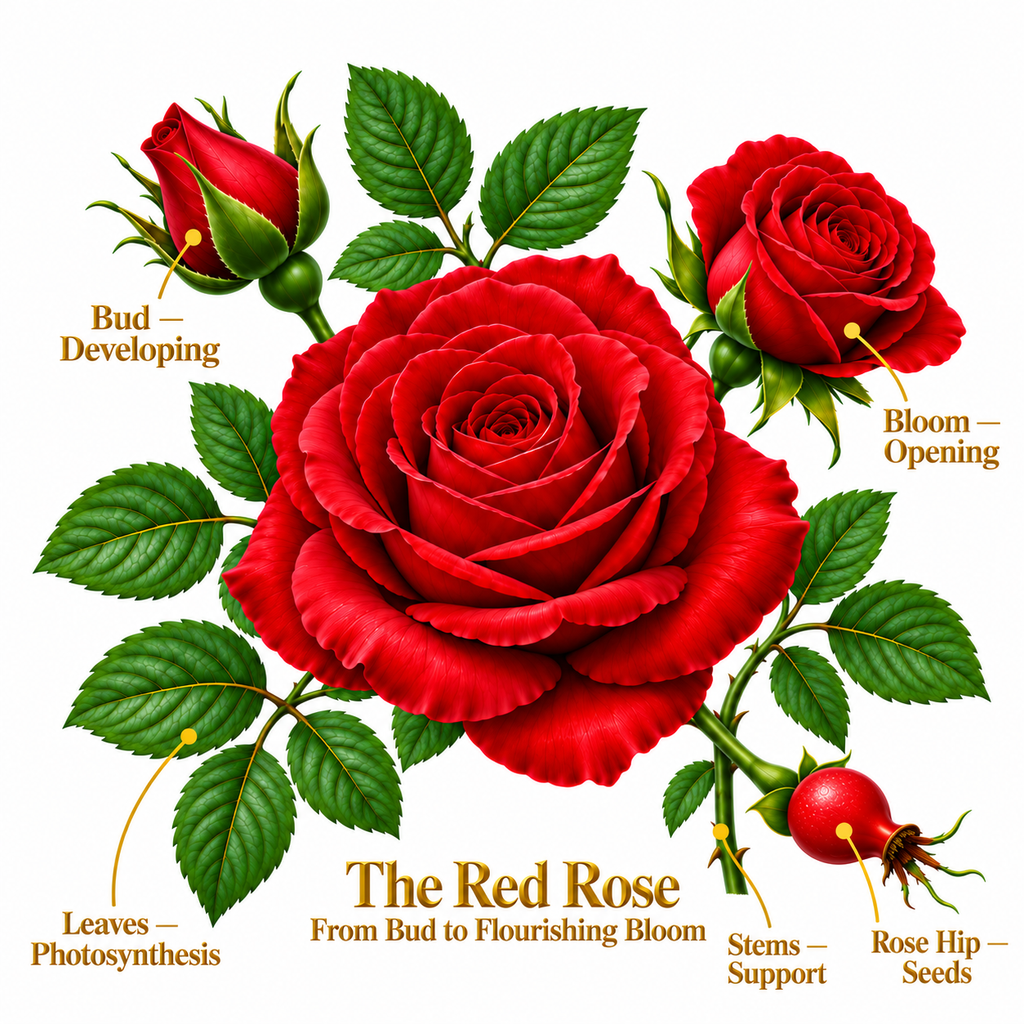
The Red Rose: From Bud to Full Bloom
- Rosebud: Developing flower.
- Opening Bloom: Unfolding petals.
- Full Bloom: Flourishing red rose.
- Leaves: Capture sunlight.
- Stems: Support and transport.
- Rose Hip: Fruit containing seeds.
if you love it, show it, as you like it.
+++++++
Be inspired, share inspirations
15 Most Fragrant Roses – David Austin, Meilland, Tantau and others
